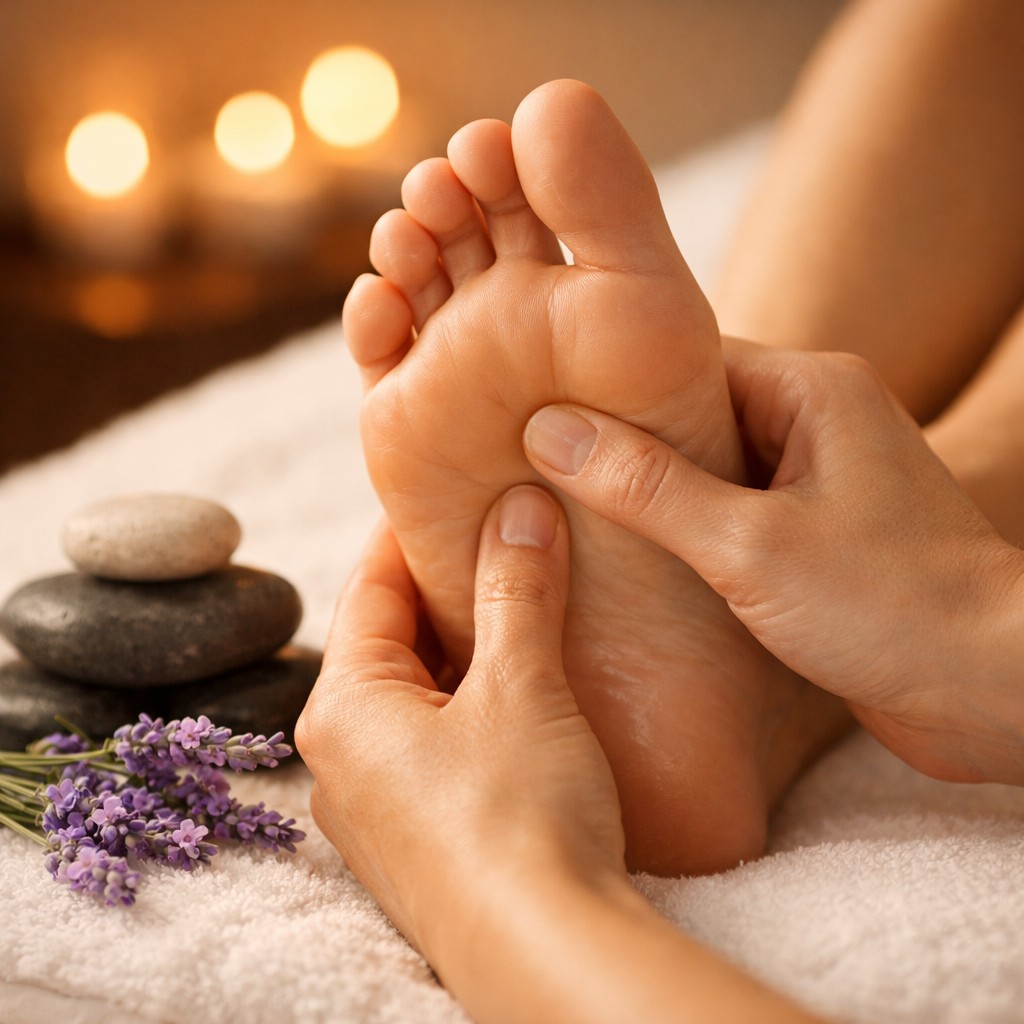
Reflexology is generally perceived as foot massage, but it is not massage. The map of the body is found on the hands and feet, and in some areas of the body. Reflexology is point pressure. It is based on opening blockages by pressing on these areas of the body. Foot massage is a different subject.
It should absolutely not be applied to MS patients, those undergoing cancer treatment, and patients with bleeding disorders. Reflexology does not treat diseases, it provides relaxation and strengthens immunity. Reflexology is not applied to babies. Giving them light foot massages relaxes them. If you do not know massage techniques, do not do it. Also, do not have it done by those you are not sure are skilled. Because babies' tissues are very sensitive, they can be damaged.
Some parts of this article are quotes, some parts are translations. Its relaxing effects are very significant, especially in stomach disorders. Good results are obtained when working with the points behind the rib cage.
History of Reflexology
It is a method that has been used for 500 years. The body is divided into ten longitudinal zones extending from the head to the tips of the toes. According to the theory, organs located within the same longitudinal zone of the body are connected to and influence each other through the energy flow in that zone.
Fitzgerald was often invited to prove the correctness of his theory. At a party he attended, a famous opera singer of the time complained of losing the upper tones of his voice. Various throat specialists had been unsuccessful in helping the artist. Dr. Fitzgerald examined the artist's fingers and toes and said the cause of the voice problem was a corn on the right big toe. When pressure was applied for a few minutes to the corresponding organ in the same zone, the artist stated that the pain in his big toe was gone. Then, when the artist tried his voice again, he was incredibly able to reach notes two tones higher than before.
Fitzgerald's theories were not well received by the medical community except for one person. This person was Dr. Joseph Shelby Riley. He had an assistant named Eunice Ingham. This woman discussed the zone theory with Dr. Riley and began developing her own foot reflexology theory in 1930. Eunice Ingham (1879-1974) became known for her work on the points on the feet that correspond to the organs in our body.
Ingham, considered the mother of modern reflexology, made a great contribution to reflexology by mapping the entire body on the feet with the help of "Zone Therapy." Eunice Ingham took her work to the public and groups outside the medical community because she understood that non-specialized people could also benefit themselves and their surroundings by learning correct reflexology techniques.
In 1938, she compiled all her memories and experiences into a book titled "Stories the Feet Can Tell." She then published "Stories the Feet Have Told," which was as popular as her first book. Today, her legacy is carried on by her nephew Dwight Byers, who heads the "International Institute of Reflexology." Feet, rarely used for treatment, squeezed into tight shoes and having little contact with air, now form a starting point for the treatment of countless diseases thanks to Dr. Fitzgerald and Mrs. Ingham.
About Reflexology Massage
We can summarize reflexology with the phrase, "Feet are the mirror of the body." In a broader sense, reflexology can be defined as releasing blocked energy in certain areas of the body through special rubbing movements applied to the feet, thereby activating the body's self-healing power.
Reflexology is a therapy that provides "balance." Reflexology therapy makes a person feel good physically, emotionally, and spiritually and restores the person's natural balance.
What kind of ailments does reflexology help with? Reflexology can be applied both for "preventive health" and for alleviating certain ailments.
- Stress
- Fatigue
- Insomnia
- Migraine
- Headache
- Women's diseases
- Menopause
- Menstrual problems
- Constipation
- Indigestion
- Back pain
- Rheumatism
- Sciatica
- Joint inflammations
- Sinusitis
- Asthma
- Prostate problems
How is reflexology used in diagnosis and treatment? Reflexology is excellent when it comes to diagnosis. A reflexology specialist can most likely diagnose the ailments of a person by touching their feet. As for treatment; like other natural therapies, reflexology does its part within the framework of "preventive health." Unlike other natural therapies, reflexology activates the body's own healing mechanism.
Reflexology Massage: Health Through Foot Massage
"Feet are the mirror of the body." Reflexology, practiced since ancient times in many cultures, is an art based on the principle that there are reflex points on the feet corresponding to all areas, organs, and systems of the body, and that these points are a mirror of the body's anatomy.
Pressure applied to these reflex points with special hand and finger techniques leads to physiological changes in the body by reducing stress. Reflexology is not massage. It involves pressing on the feet to open blocked channels. Oil is not used during massage; it is done by pressing on reflex areas; use powder to prevent fingers from slipping.
The basis of reflexology lies in the thesis that ailments arise from energy being blocked in a certain place. This drug-free therapy activates the body's self-healing mechanism by normalizing body functions. Normalized body functions provide a person with relaxation, quality sleep, and a body cleansed of toxins, as well as strengthening the circulatory system and relieving pain.
With the reflexology technique, it is possible to remove stress from the body, provide relaxation and rest without massaging the entire body.
Benefits of Reflexology
- Its main benefit is relaxation. It reduces stress and provides deep calm. It can be used as a complementary treatment in the treatment of psychological problems such as insomnia and restlessness.
- Approximately 7000 nerves are stimulated during a session.
- Blood circulation accelerates.
- Cleanses the body of toxins and waste materials.
- Provides harmony among body systems.
- Revitalizes body energy.
- Because it activates the immune system, it protects and maintains health.
- Reflexology is not foot massage or medical treatment; it does not diagnose or treat diseases. However, positive effects have been identified in the struggle, diagnosis, and treatment of many diseases.
Some Health Problems Where Reflexology is Used
(These can be helped with)
- Panic attacks
- Stress
- Depression
- Anxiety
- Back and neck hernias
- Joint pains
- Hormonal problems
- Migraine
- Migraine-type headaches
- Speech disorders
- Spasticity
- Autism
- Motor retardation (inability to walk, use arm, etc.)
- Attention deficit and memory weakness
- Calcifications
- Bedwetting in children
- Sleep disorders
- Rheumatic conditions
- Gas and constipation problems
- Menstrual pains
- Respiratory problems
- Urinary problems
- Muscle spasms
Reflexology massage performed cannot treat the above ailments and should not be perceived as such. These practices cannot replace medicine. As an alternative, it helps provide relaxation for the person and regionally facilitates your life. It may partially or completely help with some of your health problems. But we should not see it as a miraculous application. If you are going to have this massage done, be sure to have it done by a professional "Licensed Massage Therapist."
Points to Consider
- Not done for those undergoing cancer treatment.
- Not done on pregnant women, especially in the first 3 months.
- Not done during any febrile illness when the body is exhausted.
- Not done when there is arthritis and osteoporosis (bone loss) in the hands and feet, during periods of fever and swelling.
- Not done on those with vascular problems such as Thrombosis, Phlebitis.
- Not done on those with serious heart conditions.
- Not worked on the pancreas reflex in diabetics.
- Not done on varicose areas in those with varicose veins; there may be hidden varicose veins around the ankle.
- It is risky to perform on MS patients.
- Not applied during menstrual periods and periods of bleeding disorders.
Reflex Zone Therapy
It is a type of massage applied to the soles of the feet and palms of the hands to stimulate reflex points. Similar reflex points are also found on the hands, but since they are deeper, they are less sensitive. Their locations are also harder to find. Especially releasing blockages accumulated between the thumb and index finger provides relaxation in a person.
Zone Therapy: Reflexology is based on zone therapy, which uses pressure points found at various points on the feet to heal ailments. In this method, the body is divided into ten zones or energy channels that run vertically through the entire body and end at the feet. Any part of the body can be stimulated by working on the reflex area in the same zone of the foot.
Reflex Points: An easy way to remember the locations of reflex points is to visualize the projection of the body onto the soles of the feet. The big toe corresponds to the head, the inner edges of the feet correspond to the spine, and reflexes related to major organs are roughly located according to their position in the body.
Reflexology Application: In a reflexology session, the person you will apply it to should sit comfortably and their legs should be supported with cushions placed under their knees. It is very important for the person you will apply it to to be comfortable. The muscles of tense people become tight. Do not force this application on those who do not want it, you will cause harm due to tense muscles.
The person you will apply it to can also lie on their back on the floor, or sit together on a couch in a position where you can follow their facial expressions to understand their reactions to the area you are working on. Sit or kneel at your friend's feet and place their feet on your lap or on a stool.
Work on every point of the foot. Meanwhile, you may come across sensitive areas indicating a problem in the corresponding part of the body; in some places you may feel as if there are granules under the skin. Pay more attention to these to disperse these hardnesses and resolve blockages in other places. In this way, you can relieve many complaints from head and backaches to digestive problems and insomnia.
The pressures you apply to these areas can be painful, so carefully watch the facial expressions of the person you are applying it to. To heal and eliminate all ailments at once, it is better to press lightly and repeat several times rather than working for a long time on sensitive areas. Over time, as you master this, you will feel the painful areas harden like they are calcified.
Techniques: Do not massage the feet, only apply full pressure with your thumb to each specific point. Hold the foot firmly with one hand and work with the edge of the other thumb just below the nail. Press firmly for about three seconds and move millimeter by millimeter to the next point. Do not use oil as it may cause your fingers to slip. You can use a little talcum powder or work directly on the skin.
Passive Movements
A full session lasts approximately 45 minutes to an hour. The following sequence is only a brief introduction. First apply to the right, then to the left foot.
- Start the massage by relaxing the foot with a few passive movements. Hold and stabilize the ankle with one hand, and with the other, firmly hold the toes and rotate the foot four times to each side.
- Hold the foot from below the ankle with one hand and from the toes with the other. Gently stretch the foot forward and backward to release tension in the Achilles tendon. Never over-stress the joint.
- Relax the entire foot by quickly rotating it from side to side between your palms. Perform stretching movements with your toes to relieve tension.
Basic Application Sequence
- Press along the diaphragm line under the rounded part of the foot. Start from the heel and proceed along the main arch, working up to the big toe to stimulate the spine area.
- Address the entire big toe and work on every point, because this area corresponds to the head. Then, continue on each toe one by one, not skipping any point.
- Apply a series of pressures between the tendons on top of the foot. Work in each groove from the base of the toes to the ankle. These pressures relieve tension in the breasts.
- Apply pressures all over the fleshy part under the big toe to heal the lungs. On the left foot, spend more time on the heart area towards the inner edge. The heart point should be treated sensitively.
- Apply pressures in diagonal lines from the waist line to the diaphragm line. Especially for the digestive system, continue in the same way from the heel to the waist line.
- Apply pressures all around the ankle. This area corresponds to the waist, reproductive organs, and legs. Work all over the heel to prevent or relieve back pain.
Self-Reflexology
Although less relaxing than having someone else do it, you can also perform effective reflexology on yourself. Reflexology experts recommend working on your feet every day to stay healthy.
A healthy body reveals itself with healthy and pain-free feet; you should now take care to care for your feet. Either sit with one foot placed on the thigh of your other leg, or lie down with one leg bent and lean the other foot against your upright thigh.
Following the sequence given above, work slowly over your entire foot. Make a special effort on painful or sensitive areas. Increase the pressure gradually and try to relieve the pain by dispersing it. Repeat several times.