Scientists at the American College of Physicians have revealed that the echinacea plant, which has become fashionable worldwide in recent years, has no effect on the common cold and flu, and that those who drink tea from this plant while sick only feel better because they believe they will recover. In a study of 719 people aged 12–80, no significant effect of echinacea was observed on the duration of illness or the severity of symptoms. However, the Health Food Manufacturers Association in the US recalled that there are 16 studies proving that echinacea was beneficial for the common cold in the past and announced that it would not recommend the products be withdrawn from the market. The World Health Organization supports the benefit of Echinacea purpurea leaves; it considers 3 grams as a suitable daily dose.
What is Echinacea
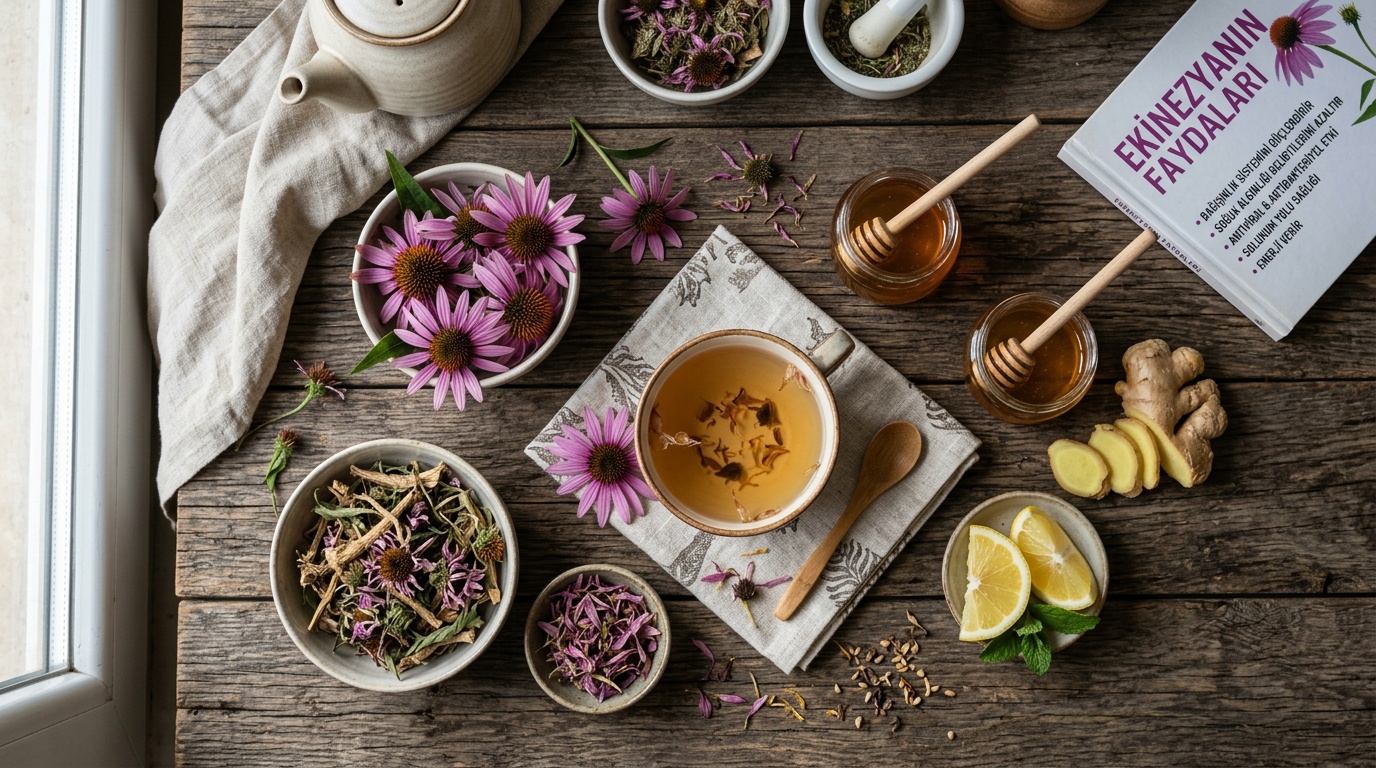
Echinacea (Coneflower — Echinacea purpurea) is one of the world's most important medicinal plants for conditions such as the common cold, flu, infection, weak immune system, and cancer prevention; it is a perennial plant that grows naturally in dry soil and plains. The civilized world learned about the plant's healing properties from the indigenous peoples of North America (Native Americans). They used the plant's root and leaves for the treatment of all kinds of wounds, infections and inflammations, poisonous insect and snake bites, sore throat and toothache, and against mumps, smallpox, and measles. The plant was also frequently used by the first settlers in America against infections.
Active Ingredients
Research since 1950 has found substances in the plant that are highly effective against bacteria, germs, and viruses. The main ones are: echinacoside, polysaccharides, polyacetylenes, glycoproteins, caffeic acid derivatives (Cichoric Acid), triglycoside, betaine, sesquiterpenes, and caryophyllene. The plant also contains copper and iron minerals, tannins, protein, fatty acids, and vitamins A, C, and E.
According to studies conducted at the University of Connecticut, 14 different active ingredients have been identified in the echinacea plant. Detailed studies have revealed that polysaccharides, alkylamides, and cichoric acid are the most important active ingredients (Dr. Michael Murray). Caftaric and cichoric acid are the two known phenolic compounds of the plant and are found more in the root part.
Effects on the Immune System
Thanks to the synergistic effect of the plant's active ingredients, it has been found to strengthen the body's defense system and aid in the treatment of infections. The most important substances that stimulate the immune system are polysaccharides, which increase the production of T-cells and the activity of natural killer cells; they are also known to accelerate tissue regeneration and reduce inflammations. Fat-soluble alkylamides and the substance echinacoside also contribute to strengthening the immune system.
Studies have shown that Coneflower increases the number of white blood cells, accelerates their migration to the infection site, and helps destroy bacteria, viruses, and other foreign microorganisms. Macrophages are the body's waste collectors; they prevent the spread of microorganisms to tissues. Natural killer cells are so named because they destroy cancerous or virus-infected cells — the activity of these cells is low in chronic fatigue syndrome, which is why echinacea can also be beneficial in this syndrome.
Echinacea also helps in the production of interferon. Interferons are glycoprotein substances that prevent the multiplication of viruses. Therefore, interferons are of great importance in shortening the duration of flu, herpes, tonsillitis, and viral diseases.
Conditions for Use
- Common cold and flu (especially when taken at the first signs, it increases its effectiveness)
- Upper respiratory tract infections and sinusitis
- Flu, herpes, and other viral diseases
- Wound healing; skin problems such as burns, insect bites, purulent wounds, psoriasis, acne, and eczema
- Arthritis (joint inflammation) and lymphatic swelling (lymphedema)
- Rheumatoid arthritis and allergies (immune system disorders)
- Support in snake and scorpion stings
- General strengthening of the immune system
- Supportive in cancer treatment (for use with chemotherapy, with doctor's approval)
The German Ministry of Health (BGA) recommends Coneflower preparations for supporting the immune system against common cold symptoms. Patients using echinacea during cancer treatment may feel stronger and the treatment duration may shorten compared to those who do not use it; however, the decision in cancer treatment always belongs to the doctor.
General Characteristics of the Plant
Echinacea, a perennial herbaceous plant, can grow up to around 140 cm. Generally growing upright, the E. purpurea species shows horizontal growth. Each stem usually bears a single flower; this flower contains petals arranged around a circular axis. The color of the petals varies from yellow to purple, red, and white; however, the color of the true medicinal plant is purplish-red. It is named from the Greek origin "echinos" (spiny) because the tips of the seed primordia become slightly prickly.
The leaves of the plant that touch the ground are spindle-shaped with serrated edges. The leaves, which generally have a hairy structure, bear characteristics of a continental climate type.
Contraindications
- It should absolutely not be used in individuals with autoimmune disease.
- It should not be used in children under 1 year of age; their immune systems are not yet mature.
- There is insufficient data on its use in children aged 1–12; it is recommended not to use it.
- It should not be used continuously for more than 10 days without a break.
- Pregnant and breastfeeding mothers should not use it.
- Those undergoing cancer treatment and MS patients absolutely should not use it.
- Those who continuously use medication should not use it without consulting their doctor.
Methods of Use
Echinacea is generally consumed as tea; tablet and capsule forms containing its active ingredients are also available. It is sold dried in herbalists, and how to use it can be learned from the herbalist. It can also be applied externally by crushing for acne, skin allergies, and insect bites.
Start using it as soon as you see flu symptoms; stop using it as soon as the flu passes. As with all medicinal plants, monitor your body well; if you experience any adverse effects, stop immediately.